Parker Solar Probe's Closest-Ever Images of the Sun: What WISPR Captured Inside the Solar Corona
Parker Solar Probe's closest-ever images reveal the solar corona in unprecedented detail — what WISPR captured at perihelion and how the spacecraft survives 1,400°C.
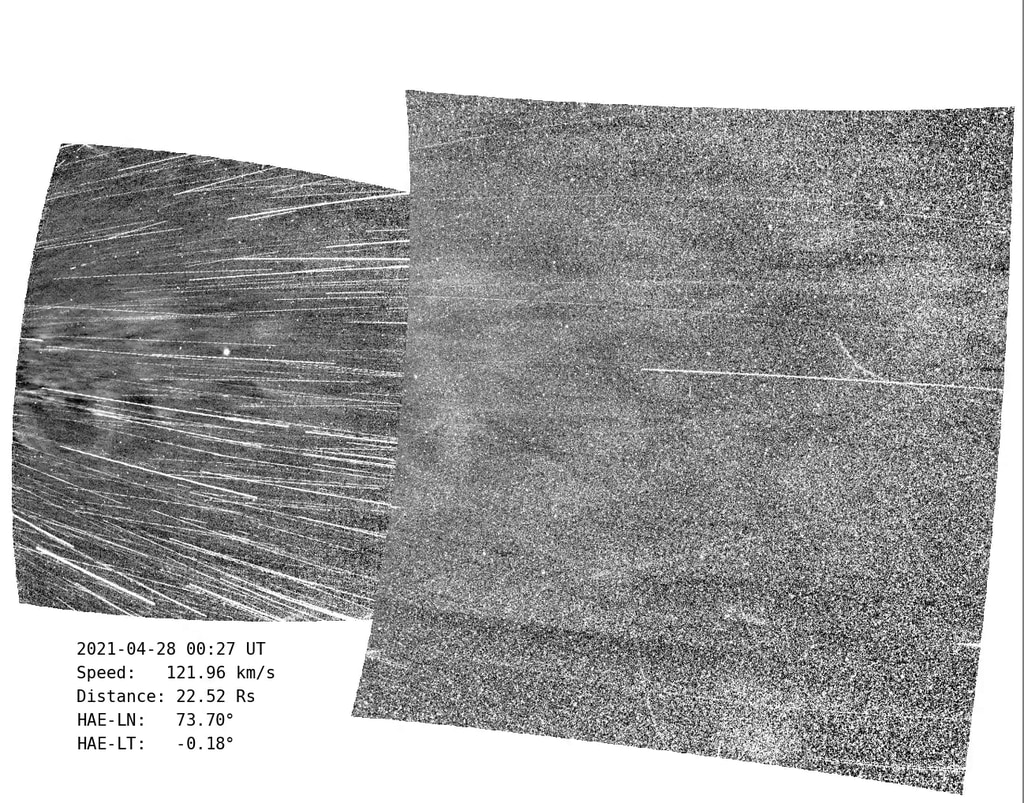
Parker Solar Probe’s closest-ever images of the Sun were captured on Christmas Eve 2024, when the spacecraft passed within 6.1 million kilometres of the solar surface — travelling at 692,000 kilometres per hour, the fastest any human-made object has ever moved, shielded behind an 11.4-centimetre carbon-composite heat shield designed to endure 1,400°C, and entirely without the ability to communicate with Earth.
Parker Solar Probe had to survive its closest approach alone. At that proximity, even the 8-minute signal delay to Earth meant that any command sent in response to an anomaly would arrive well after the window for action had closed. The spacecraft was on its own, executing a pre-programmed sequence developed over years of careful mission planning by the Johns Hopkins Applied Physics Laboratory (APL), which built and operates the spacecraft. The probe is named after Dr. Eugene Parker — the University of Chicago astrophysicist who first predicted the existence of the solar wind in 1958. NASA made an unprecedented exception to its posthumous-only naming convention so Parker could see the mission bearing his name; he died on 15 March 2022, aged 94. The mission’s Project Scientist is Nour Raouafi at APL.
It survived. And the data it brought back from that pass is already changing what scientists know about how the Sun works.
Why We Had to Get This Close
The fundamental mystery of solar physics for the past seventy years has been a question of temperature. The Sun’s visible surface — the photosphere — exists at approximately 5,500°C. Immediately above it, the chromosphere reaches tens of thousands of degrees. The outer atmosphere, the corona, extends millions of kilometres into space at temperatures exceeding 1,000,000°C — and the solar wind that the corona exhales reaches Earth still carrying energy signatures of that extreme heating.
This makes no physical sense under conventional thermodynamic models, where energy should flow from hot to cold. Something is injecting energy into the corona from below or from within, heating plasma to temperatures far exceeding the surface below it. Two candidate mechanisms have been proposed for decades: wave heating (where Alfvén waves propagating from the photosphere deposit energy in the corona through damping) and nanoflare heating (where countless small, impulsive reconnection events in the coronal magnetic field release stored energy as heat). The data required to distinguish between them has never been available — because it requires instruments inside the corona itself.
Parker Solar Probe is the first spacecraft to fly within the corona’s outer boundary, the Alfvén critical surface, where the solar wind transitions from sub-Alfvénic flow (where the Sun’s magnetic field still dominates) to super-Alfvénic flow (where the wind carries the field away). In doing so, it has become humanity’s first direct in-situ probe of the solar environment at scales that were previously only theoretically accessible.
What the Closest Pass Revealed
The perihelion pass on 24 December brought Parker within 0.04 astronomical units of the Sun — roughly eight times the Sun’s radius from the photosphere. At this distance, the spacecraft is well within the Alfvén critical surface, sampling plasma that has not yet fully transitioned to become the solar wind that eventually reaches Earth.
Initial analysis of the fields and particles data from the close approach shows structure in the solar wind that is finer and more complex than models predicted. Short-duration bursts of reversed magnetic field, called “switchbacks,” have been detected with a higher frequency and greater variability near the Sun than in the more distant measurements that previous missions — Helios, Ulysses, Wind — could provide.
The switchbacks are not merely an interesting anomaly; they may be direct signatures of the wave-heating or nanoflare processes operating at the corona’s base. Their statistical properties — duration, amplitude, frequency distribution — constrain the models in ways that are already forcing revisions to how theorists describe coronal heating.
The imagery acquired by the WISPR (Wide-field Imager for Solar Probe) instrument during the close approach captures the streamer belt — the equatorial band of dense plasma that structures the inner solar corona — with unprecedented resolution. Individual plasma structures that were previously seen only as diffuse brightness enhancements in coronagraph imagery from 1 AU are resolved into filamentary, dynamic features that trace the magnetic geometry of the inner corona with startling clarity.
The Engineering Behind Survival
Parker Solar Probe’s survival of twenty-two perihelion passes (the December 2024 approach was its 22nd) is a testament to thermal engineering in an extreme environment.
The heat shield — officially the Thermal Protection System (TPS) — is a 11.4 cm thick sandwich of carbon foam between two carbon-carbon composite facesheets, coated with a ceramic white paint to maximise solar reflectance. It faces the Sun continuously, protecting the spacecraft bus behind it, where temperatures remain close to room temperature even as the shield reaches over 1,400°C.
The only surfaces that protrude from behind the shield are the solar panels, which are articulated to avoid direct exposure during the hottest phases of each perihelion, and the antenna. The solar panels themselves use a special cooling system that actively circulates coolant to prevent thermal damage during the near-Sun periods.
The spacecraft also carries no conventional propellant thrusters for attitude control near perihelion — the thermal environment makes liquid propellant use problematic at that proximity. Navigation is handled by star trackers and reaction wheels, with course corrections performed at greater distances from the Sun where temperatures are manageable.
A Mission That Keeps Breaking Records
Parker Solar Probe is designed to make 24 progressively closer orbits of the Sun, with each series of Venus gravity assists dropping the perihelion lower. The mission’s final designed perihelion pass, expected in 2025, will bring it within approximately 6.16 million km of the photosphere — the closest approach possible without the spacecraft entering the corona’s bulk plasma.
The mission is funded through 2025, with extended mission possibilities depending on the spacecraft’s health. After 22 passes, Parker is showing no significant degradation. If the mission is extended, each additional pass at the closest distance provides irreplaceable data at scales that no future spacecraft is currently funded to achieve.
What Parker Solar Probe is teaching us about the Sun will ultimately be about more than stellar physics. The Sun’s variable output — its storms, its winds, its energetic particle events — is the dominant driver of the space weather environment that every operational satellite, every GPS signal, and every future crewed deep space mission must account for. Understanding it begins, literally, with getting close. For the complementary view from a different orbital vantage point, see Solar Orbiter’s first images of the Sun’s south pole.
Related articles
Solar Orbiter's First Images of the Sun's South Pole — What They Reveal About Our Star
Solar Orbiter captured the first-ever images of the Sun's south pole in 2025, revealing a chaotic magnetic field at solar maximum. Here's what the images show and why they matter for space weather forecasting.
Read →AnalysisHow Earth's Magnetic Field Protects Life — and What Happens When It Weakens
Earth's magnetic field protects life from solar wind, enables animal navigation across thousands of kilometres, and its current weakening already affects satellites. Here's why it matters beyond atmospheric shielding.
Read →GearBest LEGO NASA and Space Sets for Adults 2026: Icons, Technic and UCS Ranked
Best LEGO NASA and space sets for adults in 2026 — Icons Saturn V, Space Shuttle Discovery, ISS and Technic Mars Rover ranked by build quality, accuracy and display value. EU prices.
Read →