Vulcan's fifth flight failed 10 minutes after liftoff on November 15. ULA's preliminary finding points at inadequate fuel supply to the BE-4 booster engines, not the engines themselves.
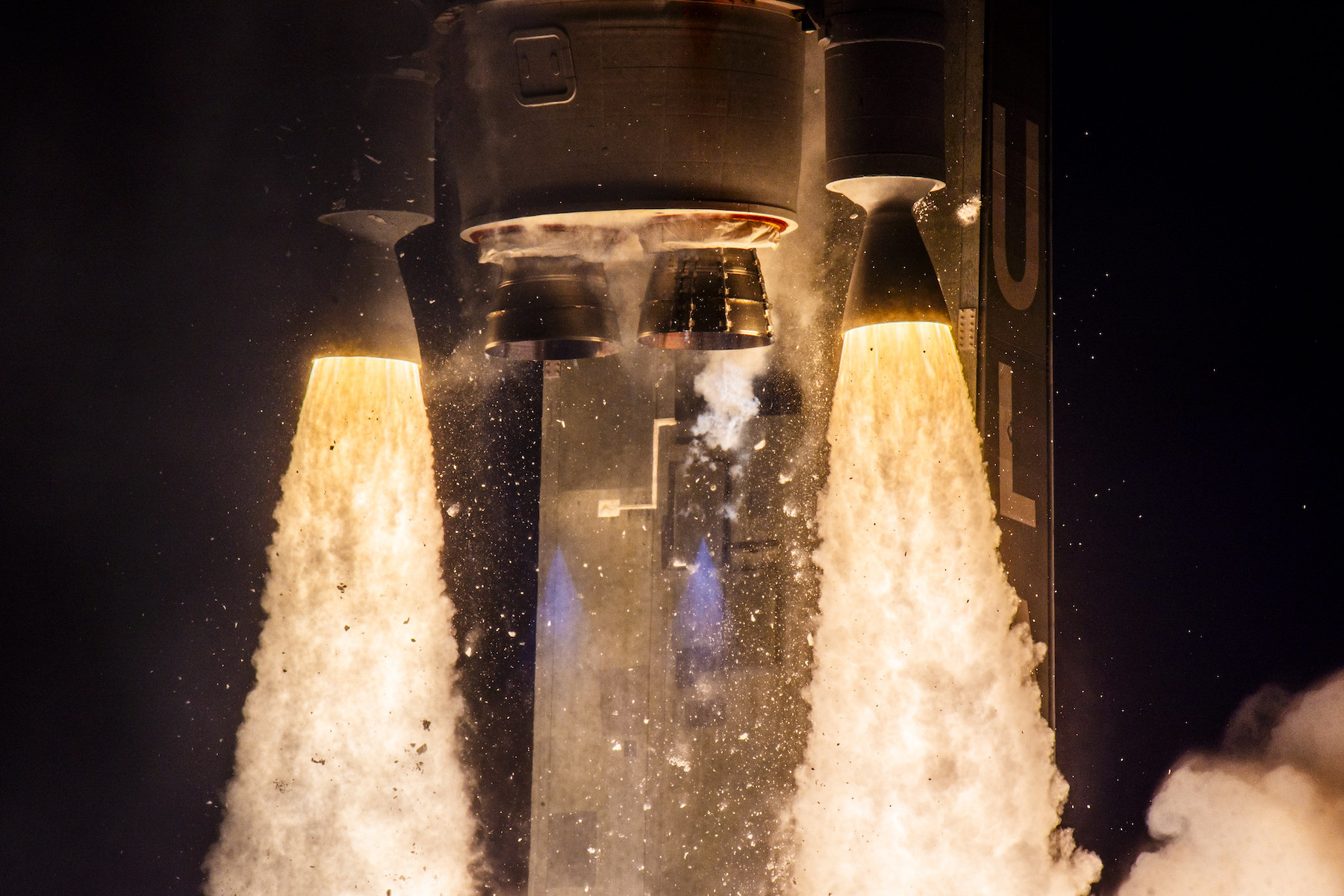
United Launch Alliance — Close-up of Vulcan Centaur's twin BE-4 engines and Centaur V upper stage igniting at liftoff on the Cert-2 flight test, October 4, 2024. Not the failed November 15, 2026 launch, but the same engines and upper stage now under investigation.
United Launch Alliance’s Vulcan rocket suffered its first total mission failure on November 15, losing 40 satellites for Amazon’s Leo broadband constellation about 10 minutes after liftoff. It was Vulcan’s fifth flight and its first since February. ULA’s preliminary finding, issued November 18, points at an inadequate supply of fuel to the two BE-4 engines on the first stage, not a problem with the engines themselves.
That distinction matters more than it sounds. An engine that underperforms is a design or manufacturing problem. An engine starved of propellant it needed is a plumbing problem somewhere else in the vehicle, and ULA has not yet said where.
A Launch That Had Already Slipped Twice
Vulcan’s return to flight was not smooth even before the countdown clock hit zero. A Friday attempt scrubbed over a nitrogen plant problem. Saturday brought a network issue. Sunday’s countdown held at T-minus 20 seconds for an unexplained technical issue before resuming at the end of the window, and ULA has not said whether that hold connects to what happened eight minutes later.
This was also a comeback flight in a more specific sense. Vulcan had been grounded for nine months after a solid rocket booster nozzle burned through during the February USSF-87 mission. ULA calls the six Northrop Grumman GEM 63XL boosters on this flight “nominal, following nozzle improvements implemented for this launch,” which is one part of the vehicle this investigation has already cleared.
Where It Went Wrong
Vulcan lifted off at 12:40 p.m. EST (1740 UTC) from Space Launch Complex 41 at Cape Canaveral Space Force Station, generating about 3.8 million pounds of combined thrust from its six solid boosters and two BE-4 first-stage engines. The solids burned out and separated cleanly around 1 minute 35 seconds into flight, exactly as planned.
What came after did not go as planned. The BE-4s fired longer than ULA’s pre-launch timeline called for, and stage separation from the Centaur V upper stage happened later, lower, and slower than intended. Telemetry showed the Centaur making unusual orientation adjustments early in its own burn, the kind of correction a stage makes when it is trying to compensate for an energy deficit it was not designed to absorb. ULA’s own words: “low first stage performance” left Vulcan “low in altitude and below minimal velocity to reach orbit” by the time the stages separated. Any chance of reaching orbit was gone by about 10 minutes into the flight.
Why Thrust, Not the Engine, Is the Suspect
The BE-4 is a methane-fueled, oxygen-rich staged-combustion engine built by Blue Origin, rated at roughly 550,000 lbf at sea level in its original configuration and uprated to about 640,000 lbf. Vulcan flies two of them on its first stage. Blue Origin’s own New Glenn flies seven. Both rockets draw from the same engine family, which is exactly why ULA’s choice of words matters: a feed-system shortfall implicates the plumbing between Vulcan’s tanks and the engines, not the combustion chamber, turbopump, or injector design the two vehicles share. Thrust itself is only part of how much mass a rocket can send to orbit; the other half is how efficiently the engine converts propellant into exhaust velocity, which is the specific impulse that sets the real ceiling on any rocket’s performance. An engine denied propellant cannot reach its rated specific impulse at all, regardless of how well it was built.
ULA has not named the specific component, whether a valve, a line, a tank pressurization system, or something else, that failed to deliver adequate flow. Until it does, “inadequate fuel supply” describes a symptom, not a cause.
What Amazon Lost
The 40 satellites were Amazon’s largest single batch for its Leo broadband constellation, meant to bring the total deployed to 436 out of the 3,200 to 3,300 satellites the first-generation system needs to reach full coverage. Amazon has hedged its launch dependence more aggressively than most constellation operators, with 38 Vulcan launches, 24 New Glenn launches, 24 Ariane 6 launches, and 13 Falcon 9 launches already under contract, a diversification strategy increasingly common across the launch market as operators try to avoid being hostage to any single vehicle’s schedule.
The hedge looks less comfortable today than it did a week ago. New Glenn has been grounded since a May 28 pad explosion traced to an oxygen valve on one of its seven BE-4s, and the BE-4s on this Vulcan flight were already flying with a Blue Origin retrofit issued after that explosion. Two of Amazon’s four launch providers now share an engine family that has had two separate anomaly investigations open in the same calendar year, even if neither has yet been pinned on the engine itself.
A Second Grounding, With No Return Date
Vulcan is grounded again, with no return-to-flight date set. The FAA is overseeing ULA’s investigation and must approve the final report and any corrective action before Vulcan flies again, a process that follows the same pattern as the nine-month grounding after February’s booster anomaly. The U.S. Space Force had already paused Vulcan’s national security missions after that earlier failure, a pause whose status has not been updated since.
NASA has its own stake in the outcome. The agency is evaluating Centaur V as an upper-stage option for the Space Launch System on Artemis 4, and the preliminary finding, pointing away from the Centaur rather than at it, leaves that option’s technical case intact for now. NASA Administrator Jared Isaacman posted that “Artemis, Moon Base, and the nation need ULA,” a statement about institutional stakes more than engineering ones. ULA CEO Mark Peller struck a narrower, more defensible note at a Washington Times event three days after the failure: the six solid boosters were clean, the Centaur lit and ran as commanded, and the first stage alone left the rocket in what he called a low-energy state it could never climb out of. That is a precise description of where the failure happened. It is not yet an explanation of why.