How Spacecraft Thermal Control Works: Keeping Satellites Alive in Extreme Temperatures
How does spacecraft thermal control work? From MLI blankets and heat pipes to phase change materials — a clear guide to keeping satellites at 20°C across a 270°C temperature swing.
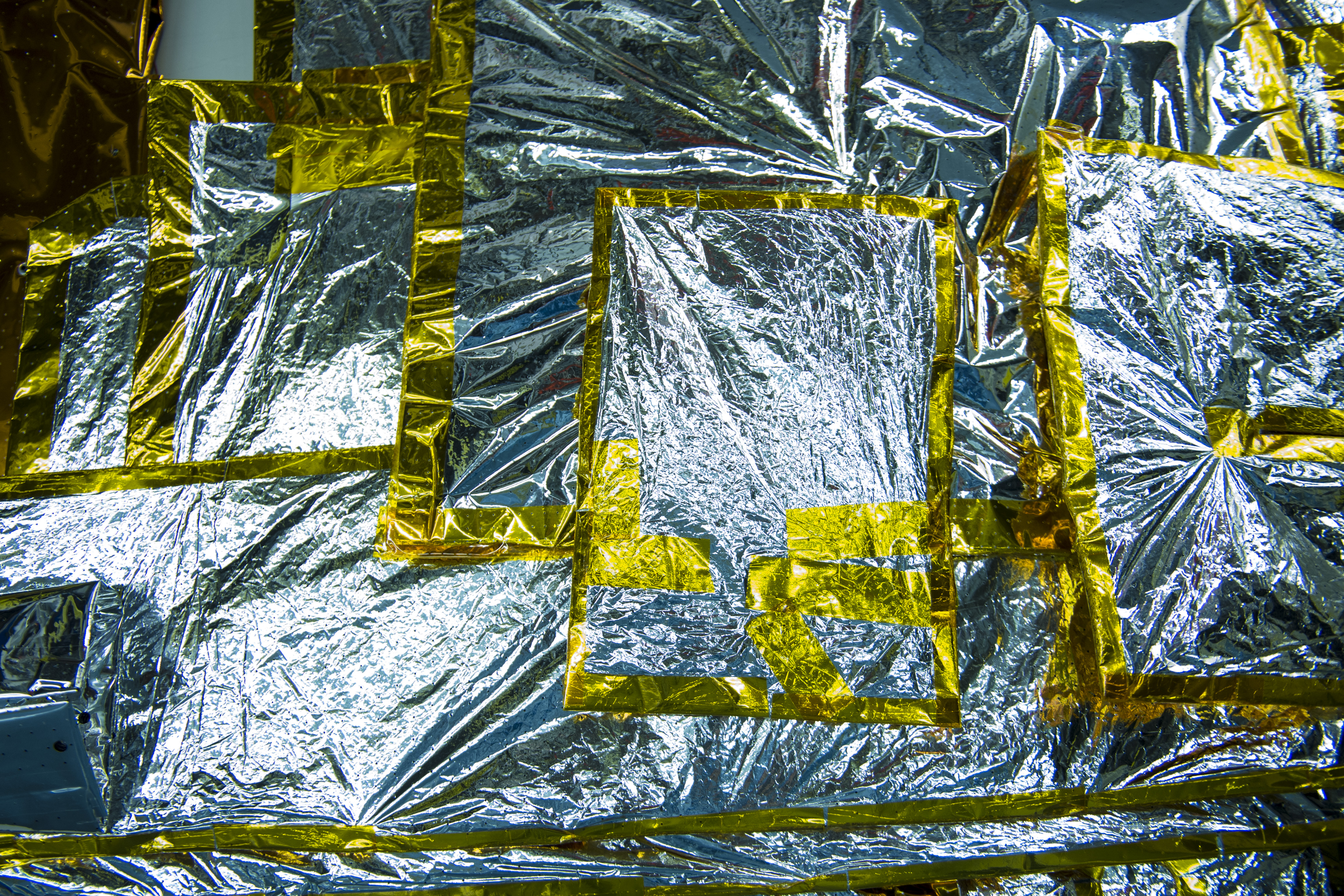
Spacecraft thermal control is one of the least visible — and most critical — disciplines in satellite engineering. In the vacuum of space, heat behaves in ways that defy everyday intuition: there is no air to carry warmth away from a hot component, no breeze to cool an overheated battery, no convection of any kind. The thermal control system must keep everything alive while the environment around the spacecraft swings from -150°C in eclipse to +120°C in direct sunlight — a delta of 270 degrees Celsius, often within the same orbit.
The target is almost always 20°C. That precise temperature is not arbitrary.
Key parameters
| Parameter | Value |
|---|---|
| Operational temperature target | 0°C to +40°C (electronics) |
| LEO eclipse fraction | up to 40 min per 90-min orbit |
| MLI effective emittance | 0.003–0.01 |
| CCHP working fluid (typical) | Ammonia or propylene |
| Stefan-Boltzmann constant | 5.67 × 10⁻⁸ W/m²K⁴ |
| ISS EATCS ammonia flow rate | 725 kg/hour |
Why 20°C Is the Magic Number
At 20°C, semiconductor leakage current is minimised, which preserves the integrity of digital logic and reduces power consumption. Lithium-ion batteries maintain their chemical stability and capacity within a narrow thermal band centred around room temperature. Quartz oscillators — the timekeeping hearts of communication systems — exhibit minimum frequency drift close to this value. Deviate too far in either direction and mission-critical systems begin to fail silently.
The challenge is that this 20°C sweet spot must be maintained inside a sealed metal box orbiting through an environment that provides neither assistance nor mercy.
The Physics of Surface Properties
The first line of defence is passive: the control of the α/ε ratio, where α is solar absorptance and ε is infrared emittance. By selecting specific surface coatings or applying Multi-Layer Insulation (MLI), thermal engineers dictate how much solar energy the spacecraft absorbs and how much waste heat it radiates back into space.
MLI is perhaps the most recognisable element of spacecraft thermal design — those crinkled gold or silver blankets visible on almost every satellite ever launched. Each blanket consists of dozens of thin polymer sheets separated by mesh spacers, creating a stack of near-vacuum gaps that dramatically reduce radiative heat transfer between layers. A well-designed MLI blanket can reduce heat loss by a factor of 100 or more compared to bare metal.
For components generating significant waste heat — power amplifiers, processors, battery packs — passive radiators exploit the Stefan-Boltzmann Law (P = εσAT⁴) to dump energy. The radiator surface is sized to reject the required power load at the maximum operating temperature, often aided by Constant Conductance Heat Pipes (CCHPs). These devices move thermal energy using a working fluid in a closed loop, with no moving parts, no power consumption, and exceptional reliability over mission lifetimes measured in decades.
Active vs. Passive Control
Passive measures work well for stable, predictable thermal environments. But many missions require something more responsive.
During long eclipse periods — when a satellite in low Earth orbit passes through Earth’s shadow for up to 40 minutes per orbit — survival heaters activate to prevent components from dropping below minimum operating temperatures. These are simple resistive heaters controlled by thermostats or, on more sophisticated spacecraft, by the On-Board Computer based on a network of thermistor readings distributed across the structure.
For high-specification missions with demanding power budgets, Phase Change Materials (PCMs) are increasingly integrated into the thermal architecture. PCMs act as thermal capacitors: they absorb excess heat during peak power operations by undergoing a solid-to-liquid phase transition at a precisely engineered temperature, then release that stored heat slowly during eclipse. This dramatically reduces the amplitude of thermal cycling that components must endure over a mission lifetime.
The CubeSat Problem
The trend toward miniaturisation in small satellites has created a thermal engineering crisis that the industry is still working to resolve.
Traditional CubeSats used low-power, low-heat payloads — the thermal challenge was keeping things warm during eclipse, not cooling them during operation. That calculus has reversed. Modern 6U and 12U platforms carry high-performance processors, RF amplifiers, and imaging systems that generate heat densities comparable to full-sized satellites, packed into a fraction of the volume.
Passive radiators scale with surface area. A 12U CubeSat has perhaps one-tenth the external surface area of a traditional 100 kg satellite, but may carry payloads generating a comparable heat load per unit volume. Deployable radiators — panels that unfold after launch to increase radiating area — partially address this, but introduce mechanical complexity and failure modes.
The emerging answer for high-power density small satellites may be Mechanically Pumped Fluid Loops (MPFLs): active cooling systems that circulate a heat transfer fluid between heat sources and radiators. MPFLs have been used on large platforms like the International Space Station — where the External Active Thermal Control System (EATCS), designed by Boeing, circulates ammonia through 1.5 kilometres of tubing at flow rates of up to 725 kg/hour — for decades. Miniaturising this technology to CubeSat scale while maintaining reliability over multi-year missions is an unsolved engineering challenge that several teams, including groups at ESA’s ESTEC in Noordwijk and NASA’s Jet Propulsion Laboratory, are actively pursuing.
The satellite at 20°C in a 270-degree environment is, in many ways, one of the most elegant demonstrations of applied physics in modern engineering. It just happens to be hurtling through space at 7.8 km/s — through the thermosphere, the dynamic atmospheric layer that makes every aspect of this thermal problem harder. See how the thermosphere affects LEO satellites for the full picture of the environment these systems must endure.
Related articles
Green Propellant vs Hydrazine: How Arkadia Space's In-Orbit Test Changes Satellite Propulsion
Arkadia Space's in-orbit green propellant test validates a non-toxic hydrazine replacement for small satellites. Here's how high-performance green propellants compare to hydrazine — and why the industry is finally switching.
Read →AnalysisLagrange Points: Where JWST Lives and Why L4/L5 Are Crowded
Lagrange points are positions where a small body can orbit in sync with two larger masses. Why L1, L2, and L3 are unstable but useful, why L4 and L5 are stable and ancient, and what JWST's halo orbit at L2 costs to maintain.
Read →GearBest Astronomy Apps 2026: SkySafari, Stellarium and What Each One Is For
Best astronomy apps in 2026 ranked by actual utility — SkySafari 7 Pro, Stellarium Mobile, Star Walk 2 and the free tools that complement them. What each app does well and who needs it.
Read →