How the Thermosphere Affects LEO Satellites: Drag, Space Weather, and the Starlink Lesson
How does the thermosphere affect LEO satellites? From atmospheric drag to GNSS disruption — and the 2022 Starlink incident that made the stakes impossible to ignore.
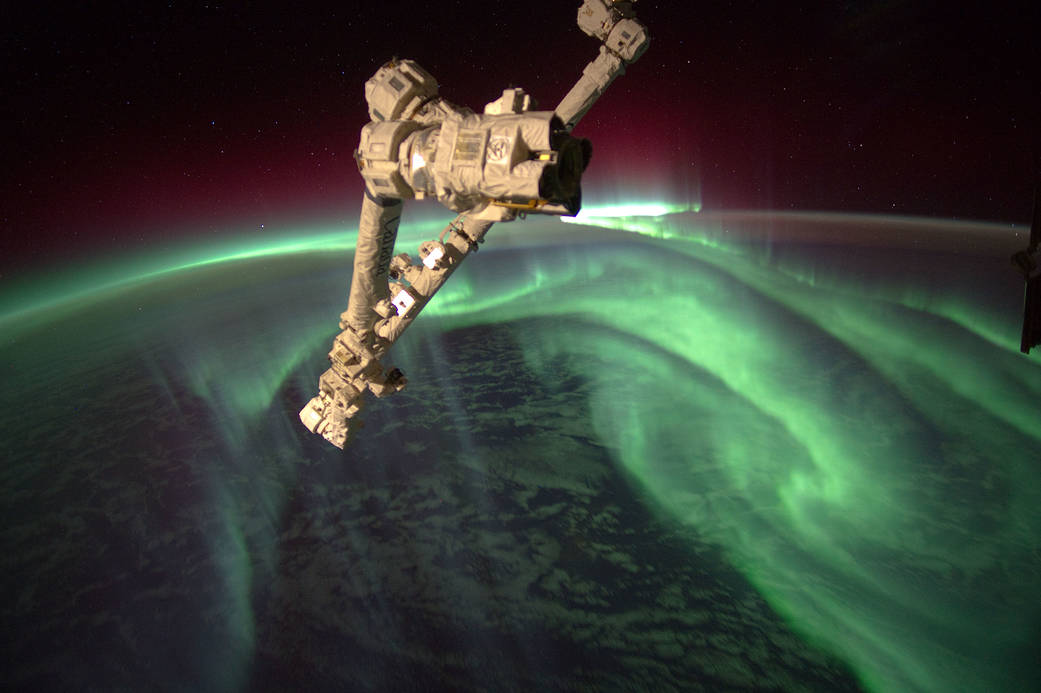
Ask most engineers how the thermosphere affects LEO satellites and the honest answer is: more than almost any other single factor. The thermosphere — extending from approximately 80 km to 600–1,000 km altitude depending on solar activity — is the environment every low Earth orbit spacecraft must be designed to survive. It is ionised, thermally extreme, electromagnetically active, and dynamically variable in ways that directly affect mission architecture, propellant budgets, communication links, and spacecraft lifetime.
Ask most people where space begins and they’ll say somewhere around 100 kilometres — the Kármán line, the internationally recognised boundary between atmosphere and outer space. What they rarely consider is what lies between that boundary and the altitude where most satellites actually operate.
Key parameters
| Parameter | Value |
|---|---|
| Thermosphere altitude range | 80–600+ km |
| Temperature range | 500–2,500 K (varies with solar activity) |
| ISS altitude (nominal) | 408 km |
| ISS reboost ΔV/year | ~60–100 m/s |
| Atmospheric density at 400 km (quiet) | ~5 × 10⁻¹¹ kg/m³ |
| Starlink 2022 loss event | 40 of 49 satellites (geomagnetic storm) |
Extreme Temperatures That Mean Almost Nothing
The thermosphere’s most counterintuitive characteristic is its temperature. The sparse molecules in this region absorb solar UV and X-ray radiation intensely, driving molecular kinetic temperatures above 2,000°C during periods of high solar activity.
Yet a spacecraft in this region does not heat up to 2,000°C. Thermal energy is transported between objects primarily through molecular collisions, and at thermospheric densities — roughly 10⁻⁷ kg/m³ at 400 km — there are simply too few molecules to transfer meaningful heat through conduction or convection. The number that actually matters for spacecraft thermal design is the flux of radiation from the Sun and the Earth below, not the thermospheric “temperature” in the classical sense.
This distinction matters enormously. A spacecraft engineer designing for the ISS at 400 km uses solar flux and albedo calculations, not thermospheric temperature, to size radiators and heaters.
Drag: The Silent Mission-Killer
What the thermosphere lacks in density it compensates for in persistence. Even sparse atmospheric particles generate measurable aerodynamic drag at LEO altitudes, and this drag accumulates relentlessly over a satellite’s operational life.
The problem is not constant — it is cyclical and unpredictable. During solar maxima, the Sun’s extreme ultraviolet output increases significantly, depositing more energy into the thermosphere. This additional energy causes the gas to expand outward, raising the atmospheric density at any given altitude. A satellite at 400 km during solar maximum encounters significantly more atmospheric resistance than the same satellite at the same altitude during solar minimum.
The practical consequence is that spacecraft operators must budget for more frequent orbital reboosts during active solar periods. The ISS, for example, requires periodic reboosts from visiting vehicles to compensate for orbital decay — and the frequency of these manoeuvres increases measurably with the solar cycle. For satellites without propulsion — CubeSats, debris objects, deployed constellations — this atmospheric breathing directly determines operational lifetime.
The most dramatic recent demonstration of this effect was SpaceX’s Starlink loss in February 2022. A geomagnetic storm struck shortly after the deployment of 49 satellites into a low 210 km parking orbit, causing atmospheric density at that altitude to increase by up to 50% above forecast levels. The satellites could not generate enough thrust to overcome the enhanced drag and raise their orbits before aerodynamic forces caused them to re-enter. Thirty-eight of the 49 satellites were lost — a $50 million lesson in thermospheric sensitivity that reverberated across the entire small satellite industry. SpaceX subsequently adjusted its deployment strategy, delaying orbital raises during elevated geomagnetic activity and raising the minimum safe deployment altitude, but the incident underscored that no constellation operator can treat atmospheric drag at LEO altitudes as a solved problem.
The Ionosphere Overlap: Signal Distortion and GNSS Errors
The upper thermosphere overlaps with the ionosphere — the region where solar radiation ionises atmospheric atoms, creating a plasma of free electrons. This ionised layer has been enabling long-distance radio communication since Marconi’s first transatlantic transmissions in 1901, but it also introduces complications for precision systems.
GNSS signals — GPS, Galileo, GLONASS — propagate through the ionosphere on their way from satellite to receiver. Free electrons slow the signals in a frequency-dependent manner, introducing errors in the apparent range measurements that can reach tens of metres under disturbed conditions. Dual-frequency receivers compensate for this by comparing the arrival times of signals at different frequencies, but the correction is imperfect and requires real-time ionospheric models.
During geomagnetic storms, the ionosphere becomes turbulent, producing rapid fluctuations in electron density called scintillation. Scintillation can cause GNSS signal lock loss, satellite communication outages, and radar interference — effects that are difficult to predict and impossible to avoid.
Auroras and the Cost of Beauty
Auroras are the thermosphere’s most spectacular feature and, for spacecraft operators, one of its most hazardous. During geomagnetic storms, charged particles from the solar wind are channelled along magnetic field lines into the polar thermosphere, where they collide with atmospheric gases and produce the characteristic green and red light emissions.
Below the visual beauty lies a serious engineering concern: surface charging. The plasma environment around a satellite during a geomagnetic storm is highly non-uniform, allowing different parts of the spacecraft to charge to different electrical potentials. When the potential difference becomes large enough, electrostatic discharge can damage solar arrays, corrupt memory, or destroy sensitive electronics. Most satellites carry mechanisms to bleed off accumulated charge, but the design of these systems requires detailed knowledge of the local plasma environment — which is itself difficult to model accurately during storm conditions.
Where Most Satellites Live
The ISS orbits between 340–420 km altitude, squarely within the thermosphere. Every logistics mission, every spacewalk, every scientific experiment aboard the station is conducted in an environment where atmospheric drag is non-negligible, space weather effects are real, and the line between “space” and “atmosphere” is a matter of definition rather than physics.
For the growing constellation operators deploying hundreds or thousands of satellites into LEO — Starlink, OneWeb, Amazon Kuiper — the thermosphere is not an abstraction. It determines the constellation altitude, the propellant mass fraction, the re-entry timeline of decommissioned satellites, and the interference environment for their communication links.
Understanding the thermosphere is not optional for anyone building or operating in low Earth orbit. It is the medium in which LEO missions live and, eventually, die. For a deeper look at how spacecraft manage the thermal consequences of the environment described here, see how spacecraft thermal control works.
Related articles
ISS Crew Shelters in Dragon as Roscosmos Attempts Structural Repair on Zvezda Leak
On June 5, NASA ordered five astronauts into a docked Crew Dragon at 9:03 a.m. EDT while Russian cosmonauts prepared to cut into the ISS's leaking PrK tunnel — a structural problem seven years in the making that no patch has permanently solved.
Read →AnalysisKessler Syndrome: The Space Debris Crisis Threatening Earth Orbit
Over 36,000 tracked objects orbit Earth at speeds that make a centimetre of debris as lethal as a hand grenade. Donald Kessler's 1978 cascade model, the current LEO situation, and why remediation may already be urgent.
Read →GearBest Astronomy Apps 2026: SkySafari, Stellarium and What Each One Is For
Best astronomy apps in 2026 ranked by actual utility — SkySafari 7 Pro, Stellarium Mobile, Star Walk 2 and the free tools that complement them. What each app does well and who needs it.
Read →