NASA's X-59 Breaks the Sound Barrier — How the Quiet Supersonic Aircraft Works
NASA's X-59 reached Mach 1.1 at 43,400 feet on June 5 — the first supersonic flight of the QueSST program. Here's the wave physics behind the quiet boom, and why this flight matters for the future of overland supersonic travel.
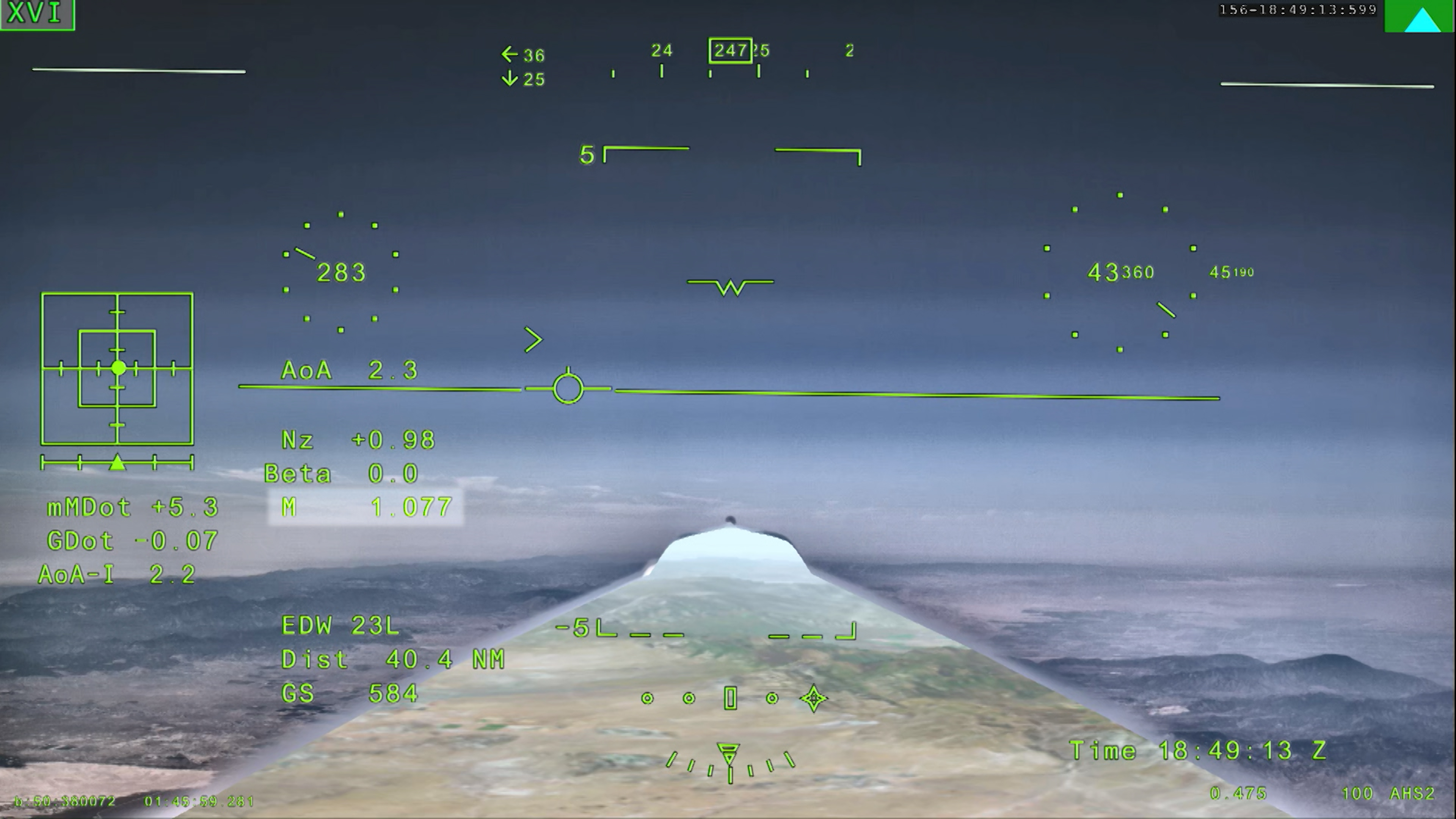
On June 5, 2026, at 11:08 a.m. Pacific time, NASA test pilot Jim “Clue” Less pushed the X-59 through Mach 1 for the first time. The aircraft reached Mach 1.1 — approximately 713 mph — at 43,400 feet over Edwards Air Force Base in California. The sound barrier has been broken tens of thousands of times since Chuck Yeager crossed it in 1947. What made Friday different is the problem the X-59 was built to solve: crossing it quietly.
From QueSST to First Supersonic Flight
The X-59 is the product of NASA’s Quiet Supersonic Technology initiative — QueSST — a research programme formally initiated in 2016 and contracted to Lockheed Martin’s Skunk Works in Palmdale, California. The programme’s mandate was precise: design, build, and fly an aircraft capable of demonstrating that the sonic boom generated during supersonic flight can be shaped into something fundamentally different from the sharp crack that grounded Concorde over populated areas.
The aircraft took nearly a decade to move from design contract to first flight. Lockheed Martin’s Skunk Works completed the X-59 airframe in 2023 and presented it publicly at a rollout ceremony in January 2024. After an extensive ground test campaign — structural loads testing, propulsion system runs, and electromagnetic interference characterisation — the aircraft made its first flight in October 2025. A scheduled maintenance period followed before flight operations resumed in March 2026. By late May, the programme had accumulated 15 flights; Friday’s supersonic pass was the sixteenth.
Friday’s Mach 1.1 pass is not the programme’s endpoint. It is the prerequisite for what comes next.
Why Sonic Booms Are What They Are
Every supersonic aircraft generates a continuous train of shock waves — pressure discontinuities that radiate outward from the nose, wings, engine nacelles, and tail surfaces as the airframe moves faster than the air it displaces. On a conventional supersonic aircraft, the shock waves generated by each part of the airframe coalesce as they propagate away from the aircraft. Shocks from the nose, cockpit, and wing leading edges merge into a single strong bow shock; shocks from the aft fuselage, tail, and engine nozzle merge into a single tail shock. What arrives at the ground is two concentrated pressure pulses separated by a few tenths of a second: the characteristic double boom.
The peak overpressure of a Concorde sonic boom at ground level was approximately 1.5 to 2 pounds per square foot. For an SR-71 at operational altitude, it could exceed 3 psf. These values translate to approximately 105 PLdB — perceived level in decibels, a unit that weights frequency content by human hearing sensitivity rather than treating all frequencies equally. At 105 PLdB, the event is comparable to a thunderclap. Windows rattle. Conversations stop.
The physics that produces that double crack is wave coalescence. Prevent coalescence and the boom disappears. That is the entire engineering thesis behind the X-59.
The Design That Prevents Coalescence
The X-59 was designed so that its shock waves do not merge across the 10 to 15 kilometres between aircraft and ground. Every geometric feature of the airframe has a specific acoustic consequence.
The aircraft is 29.4 metres long — nearly twice the fuselage length of a comparably performing aircraft — with a sharply tapering nose that accounts for nearly a quarter of that length. The gradual pressure rise generated by the long nose keeps the nose shock weak enough that trailing shocks from the cockpit and wings cannot catch up to it. The cockpit itself sits approximately 10 metres back from the nose tip, precisely to prevent its shock from interacting with the dominant nose shock during propagation.
There is no conventional forward windscreen. The pilot’s external view comes from a 4K forward-looking camera displayed on a screen inside the cockpit — an arrangement driven entirely by the need to maintain the smooth aerodynamic contour that acoustic separation requires. A conventional windscreen would create a discontinuity in the fuselage profile that generates its own shock.
The single F414-GE-100 engine is mounted atop the rear fuselage. This prevents the strong shock generated by the engine intake from interacting with the wing shocks below, a coalescence pathway that would exist if the engine were podded under the wing as on a conventional aircraft. The wing itself is a thin, highly swept delta planform with a minimised leading-edge radius to reduce shock strength at the root.
The design target: a ground-level overpressure of no more than 0.3 psf — approximately 75 PLdB. Concorde produced 105. That 30 PLdB reduction is not incremental. At 75 PLdB, the sound event is closer to a car door closing on a nearby street than to a thunderclap.
The Community Overflight Programme
Acoustic instrumentation will confirm whether the X-59 hits its 75 PLdB design target. But the data that matters most to regulators is not what the microphones record — it is what the people below the flight path hear, and whether they find it tolerable.
NASA plans to fly the X-59 supersonically over several U.S. cities at test altitudes, with a network of calibrated ground microphones recording the acoustic signature beneath the flight path. Simultaneously, trained survey teams will conduct structured interviews with residents following each overflight: did you hear anything? How would you describe it? Did it disturb what you were doing?
The survey methodology is adapted from decades of noise annoyance research in aviation and transportation psychology. The critical metric is not loudness alone but annoyance — a function of perceived loudness, frequency content, duration, and context. A sound that residents cannot identify as an aircraft, that does not interrupt conversation, and that does not wake people from sleep may be tolerable at the frequencies a supersonic service would generate. Whether 75 PLdB meets that standard under real-world conditions, across different urban environments and background noise levels, is what the surveys will establish.
Data collection is planned through 2027, with regulatory submission to follow.
The Regulatory Target
Commercial supersonic flight over land in the United States has been prohibited since 1973, when the FAA codified 14 CFR Part 91.817 — banning civil aircraft from exceeding Mach 1 over the continental U.S. The rule is a categorical prohibition, not a noise standard. It does not define an acceptable boom level because no empirical basis existed at the time for writing one.
The ICAO Committee on Aviation Environmental Protection has maintained a working group on supersonic aircraft noise certification since 2019, when it became clear that commercial programmes were approaching realistic timelines. The group — CAEP Working Group 3 — is developing a certification framework within which empirical data on human boom perception would anchor the noise limit.
Without that standard, no supersonic aircraft can be certified for overland commercial routes regardless of its acoustic performance. The X-59 is not producing a commercial product. It is producing the evidence base that allows a product to be certified. Those are different problems, solved on different timescales.
The Market That Depends on This
Current commercial supersonic development — Boom Supersonic’s Overture, targeting 2029 entry into service; Hermeus at earlier stages — is designed around overwater routes where supersonic cruise is already permitted. The transatlantic and transpacific markets are real.
But the routes with the highest yield for supersonic aviation are overland: New York to Los Angeles, currently 5.5 hours subsonic and achievable in under two hours at Mach 1.7; London to Dubai; Tokyo to Seoul. These routes combine high passenger volumes with the premium and business travellers who are the viable market for supersonic fares. They remain unavailable to any aircraft that produces a conventional boom.
The X-59’s community perception data is the first concrete step toward changing the regulatory arithmetic. ICAO standards typically require eight to twelve years from data submission to formal adoption. Friday was the beginning of that timeline.
The sound barrier is easy to break. Breaking it in a way that regulators can certify and communities can tolerate is the harder problem. Friday was the proof that the physics works. Whether the people below agree comes next.
Related articles
NASA Confirms Artemis III Crew: First Humans to Land on the Moon Since 1972
NASA has announced the Artemis III crew for the first crewed lunar landing since Apollo 17 — targeting the south pole and its permanently shadowed water ice deposits.
Read →AnalysisThe 25-Year Deorbit Rule: Why the Main Space Debris Standard Is Failing
The 25-year post-mission deorbit guideline was adopted in 2002 to control debris growth in LEO. Historical compliance has been ~50%. Mega-constellations of thousands of satellites have made the rule's underlying assumptions obsolete — and regulators are responding.
Read →GearBest LEGO NASA and Space Sets for Adults 2026: Icons, Technic and UCS Ranked
Best LEGO NASA and space sets for adults in 2026 — Icons Saturn V, Space Shuttle Discovery, ISS and Technic Mars Rover ranked by build quality, accuracy and display value. EU prices.
Read →