On June 5, NASA ordered five astronauts into a docked Crew Dragon at 9:03 a.m. EDT while Russian cosmonauts prepared to cut into the ISS's leaking PrK tunnel — a structural problem seven years in the making that no patch has permanently solved.
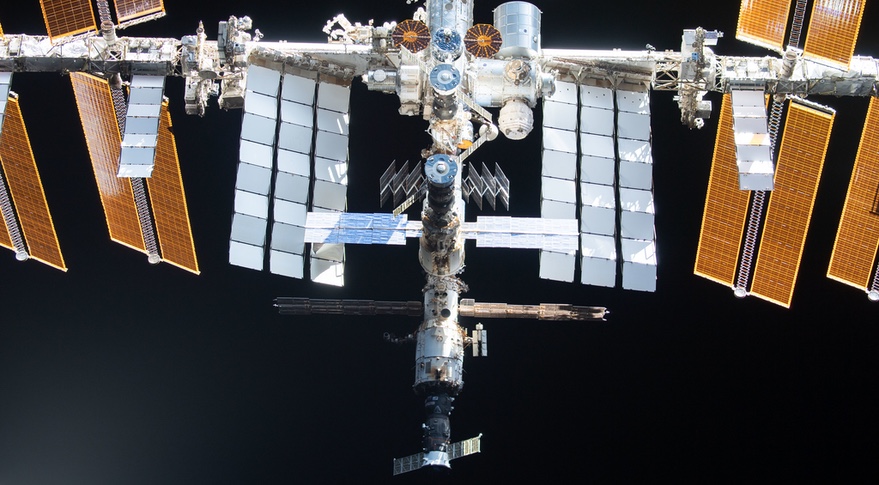
NASA — International Space Station photographed from SpaceX Crew Dragon Endeavour. The Zvezda Service Module and its PrK transfer tunnel are visible at the aft end of the Russian segment.
Shortly after 9 a.m. EDT on June 5, NASA directed five of the seven crew members aboard the International Space Station to take shelter inside the docked SpaceX Crew Dragon. Russian cosmonauts Sergey Kud-Sverchkov and Sergei Mikaev were preparing to cut into a bracket inside the Zvezda Service Module’s transfer tunnel, known as the PrK, to access a structural crack that has been leaking atmosphere since 2019. NASA determined the procedure carried elevated risk of worsening the leak or compromising structural integrity. Roscosmos paused. Less than two hours later, the crew returned to normal operations.
The immediate crisis passed. The underlying problem did not.
The PrK: Seven Years of a Known Problem
The PrK — from the Russian Переходная камера, transfer chamber — is a pressurised vestibule attached to the aft end of Zvezda, the Russian-built service module that has formed the backbone of the station’s Russian segment since its launch in 2000. The tunnel connects Zvezda to a docking port used by Progress cargo spacecraft and, periodically, Soyuz vehicles.
Engineers first detected atmosphere leaking from the PrK in September 2019. The responsible cracks are microscopic. They are not the result of a single impact or failure event but of cumulative structural fatigue in metal that has spent nearly three decades in the ISS’s operating environment: temperature swings of 300°C between sunlit and shadowed orbital passes, radiation sufficient to degrade polymer sealants over years, and low-frequency vibration generated by the station’s own systems and docking operations.
Every repair attempt between 2019 and early 2026 bought time without resolving the root cause. Roscosmos applied Germetall-1, a specialist aerospace sealant. Engineers isolated the PrK by keeping the hatch to the rest of Zvezda closed except during Progress docking operations. By January 2026, NASA confirmed stable pressure readings after the most recent round of sealing work. The relief lasted four months.
The Escalation
During Progress 95 cargo operations in early May 2026, cosmonauts detected a slow pressure drop in the Zvezda module. By the week of June 1, the leak rate had reached approximately 0.9 kilograms of atmosphere per day — double the rate recorded in May and the highest sustained level since monitoring began. New suspected leak areas were identified within the PrK beyond those previously treated.
The situation was no longer one of managing a known crack with known boundaries. The fracture network appeared to be growing.
Roscosmos proposed a more aggressive intervention: cutting a bracket inside the enclosed PrK structure to gain direct access to the crack surfaces and seal them from the inside, bypassing the indirect application of sealants that had repeatedly failed to hold over the long term. The logic was consistent with the repair history. The risk was structural.
The Safe Haven Protocol
NASA’s concern centred on the systemic nature of the problem. The PrK is a pressurised transfer tunnel whose integrity depends on the interaction of its components as a whole. Cutting into the structure without complete knowledge of where the fracture network extends risked converting a manageable chronic leak into an acute depressurisation event.
Shortly after 9 a.m. EDT, NASA invoked the station’s safe haven protocol. When docked at the ISS, Crew Dragon functions as an independent lifeboat capable of undocking and returning the crew to Earth without assistance from the station’s systems. Five crew members transferred to the Dragon and sealed the hatch: Crew-12’s Jessica Meir (NASA), Jack Hathaway (NASA), Sophie Adenot (ESA) and Andrey Fedyaev (Roscosmos), along with NASA astronaut Chris Williams, who had arrived separately aboard Soyuz MS-28 in November 2025.
Kud-Sverchkov and Mikaev remained in the Russian segment to conduct the repair work. The crew in Dragon was positioned to undock and evacuate within minutes if the procedure caused rapid depressurisation. Roscosmos paused before the cutting began, conducted additional measurements, and stood down from the structural intervention. The hatch was reopened and station pressure was reported stable at normal levels.
Two Agencies, One Module, Two Diagnoses
The technical disagreement between NASA and Roscosmos on the PrK has persisted since 2019 and defines every decision about how aggressively to intervene.
Roscosmos engineers attribute the cracking primarily to metal fatigue from accumulated micro-vibrations: the low-amplitude, high-cycle loading generated by equipment operation, docking events and crew movement over decades. Under this model, the cracks are a predictable consequence of the module’s age, and the right repair is direct access and sealing of the fracture surfaces.
NASA’s assessment is multifactorial. Agency engineers point to the combination of pressure cycling (the PrK is repeatedly pressurised and depressurised with each Progress docking), mechanical and residual stress from original manufacturing, material degradation from radiation exposure, and the thermal cycling environment. Under this model, sealing visible cracks without addressing the underlying stress state will continue producing new fractures at unpredictable locations. The observed pattern since 2019 is consistent with that assessment.
The disagreement matters practically. If Roscosmos is correct, a sufficiently direct repair could resolve the problem. If NASA is correct, the PrK is in progressive structural failure and no localised repair will arrest it.
The Broader Context
The PrK leak is now classified at NASA’s highest internal safety concern category, combining high likelihood of recurrence with meaningful consequences if it escalates. The station’s core systems remain functional and habitable volume pressure is stable. But June 5 demonstrated that the aggressive repair options carry risks NASA is unwilling to accept without further analysis, while the passive options have repeatedly failed to hold.
The ISS is authorised to operate through 2030, after which NASA plans to transition human presence in low Earth orbit to commercially operated platforms. Axiom Space is building its own station, and other commercial platforms are at various development stages. The PrK situation does not immediately threaten that timeline. It is, however, a precise illustration of the challenge facing any structure designed for a 15-year operational life that is now entering its fourth decade in orbit. The thermal cycling, the radiation, the vibration: they accumulate. The metal remembers.
The bracket cutting is still an option on the table. So is the Dragon, docked and ready.